



Cover photo: @lapuertaontheroad
We organize a team breakfast on a Thursday morning, a product launch brunch on a Saturday, an informal meeting over pancakes and coffee. The corporate brunch has settled into Parisian habits: less formal than a seated lunch, more convivial than a simple coffee break, it creates a setting where hierarchies fade and conversations flow. No need for an impersonal meeting room or a caterer in a suit: you’re looking for a place that breathes, a menu that delights, and an atmosphere that puts people at ease.
Whether the goal is to celebrate a collective success, bond a new team, or simply offer a moment of disconnection to employees under pressure, brunch answers a simple need: getting together over something good, without protocol. All that’s left is to decide where to do it, how to budget it, and which formulas to choose so that everyone finds what they’re looking for.
🎯 Why choose brunch for a professional event
A format that breaks the codes of the classic seminar
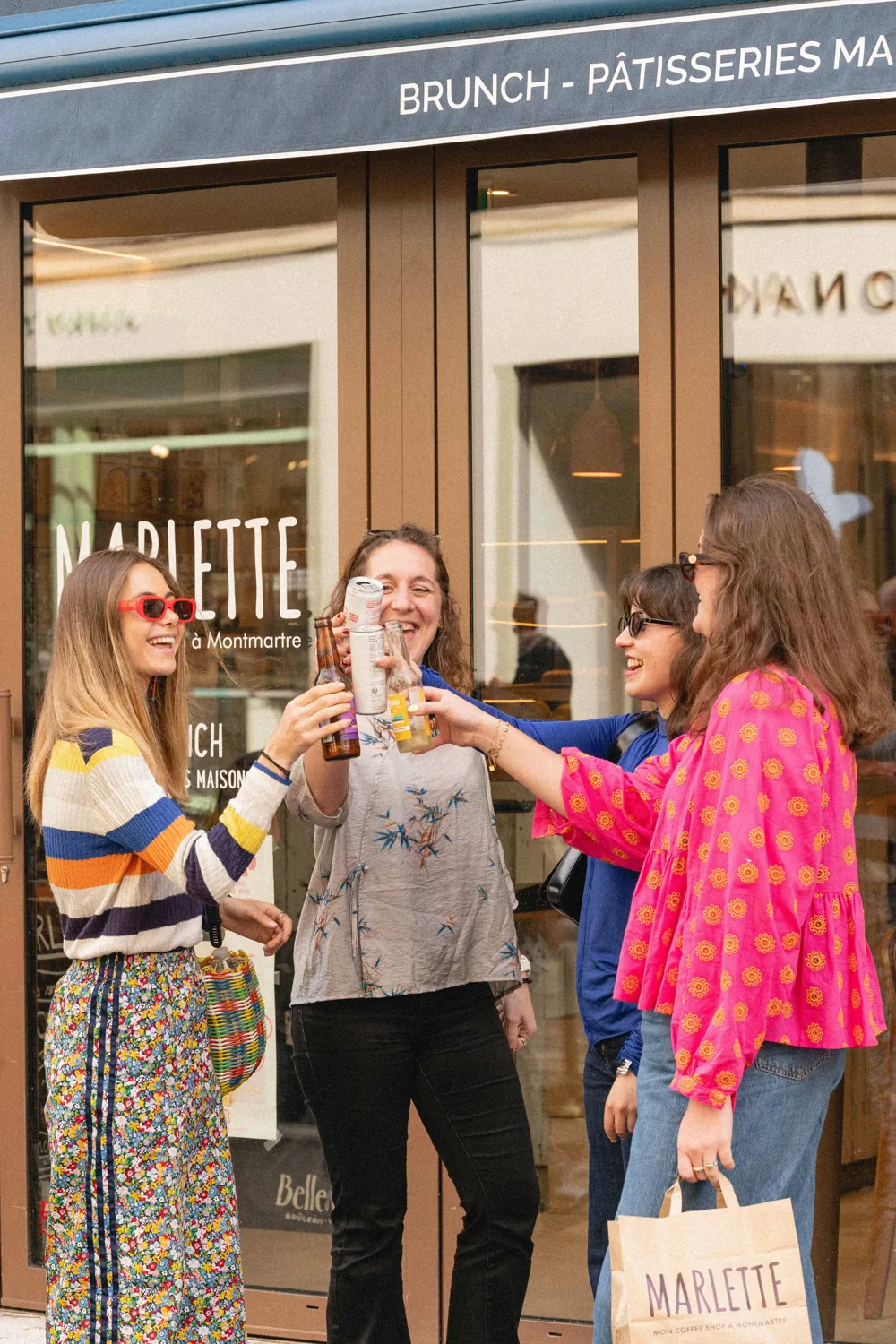
Brunch stands out in the landscape of corporate events. No PowerPoint projected onto a white wall, no name badges pinned to a jacket. You sit around a table, share plates, pass the sugar. This apparent simplicity creates a different dynamic: exchanges become more direct, less filtered by professional posture. An intern might find themselves chatting about pancakes with the marketing director without anyone finding it strange.
Parisian cafes that offer corporate brunches capitalize precisely on this shift. No anonymous seminar room: you privatize a corner of a terrace on rue des Abbesses, you book the cozy back room of a coffee shop on rue des Martyrs. The place matters as much as the menu, it says something about the company culture, its openness, its ability to go off the beaten path.
💡 Our advice
Prefer a neighborhood venue with real identity. Generic spaces like business hotels kill the intended effect: you want the team to remember the place, not to forget where they were three days later.
Timing that frees up the rest of the day
A corporate brunch scheduled for 10:30 am on a Saturday leaves the afternoon free. An early breakfast at 8:30 am on a weekday allows the normal course of the day to resume around 10:30 am, without pushing back every meeting. This hybrid time slot, neither too early nor too late, offers valuable flexibility when you want to bring together scattered teams without paralyzing the schedule.
For partially remote employees, brunch also becomes an excuse to travel. People more readily agree to cross Paris on a Saturday morning to meet colleagues over a good coffee than for yet another video call. The format creates the event, whereas a simple weekday lunch would come across as just another obligation.
A manageable budget, far from standing cocktail parties
Organizing a standing cocktail party for thirty people in a privatized venue quickly costs several thousand euros. A well-calibrated corporate brunch runs around 25 to 40 euros per person, all inclusive: sweet and savory buffet, hot drinks, fresh juices, service. Some venues offer group packages starting at 10 people, with partial privatization and an adapted menu.
This budget accessibility allows for recurrence: you can organize a quarterly brunch to celebrate results, whereas a gala dinner would remain exceptional. Regularity creates connection, and connection often matters more than a single spectacular event.
📋 The different corporate brunch formulas

À la carte seated brunch: for demanding small groups
For up to 8-10 people, a seated brunch works well: everyone orders what they want, service flows smoothly, and conversations happen naturally. You book a large table, ask for the bills to be grouped together, and that’s it. This formula suits informal meetings (project debrief, welcoming a new manager, relaxed strategic discussion).
Parisian coffee shops generally accept this type of reservation on weekdays, outside peak hours. Some, like venues specializing in corporate brunches in Paris, welcome this type of request in the afternoon only (3pm-5pm on weekdays, 3pm-6pm on weekends), when the room breathes and teams can settle in without any crowding.
- Advantage: maximum flexibility, everyone builds their own plate
- Disadvantage: not well suited beyond 10 people (service time too long)
- Budget range: 22-35 € per person, drinks included
Custom buffet: the solution for groups of 15 to 40
As soon as you exceed a dozen guests, the buffet becomes the obvious choice. The principle: the cafe or caterer prepares a selection of sweet and savory dishes arranged on a central table, and everyone helps themselves as they like. Fresh pastries, seasonal salads, scrambled eggs, pancakes, fruit baskets, pressed juices, coffee thermoses. No downtime, no waiting, and a relaxed atmosphere where people circulate.
This formula requires a bit of planning: you need to communicate the number of participants a week in advance, specify any particular dietary requirements (vegetarian, gluten-free, allergies), and confirm the menu. Some venues offer a fixed rate per person, others draw up a custom quote. In any case, you gain in fluidity what you lose in individual personalization.
Number of people, desired time, estimated duration (1.5 or 2 hours), dietary requirements. The more precise you are, the better calibrated the buffet will be.
Sweet-savory balance, presence of protein (eggs, salmon, ham), visible vegetarian options. Ask to taste in advance if the budget allows.
Full or partial privatization, wheelchair access, cloakroom if it’s cold season, space to set down laptops and phones (even though we recommend against working during the event).
Standing cocktail brunch formula: for launches and inaugurations
When the goal is more about networking than feeding a team, the standing cocktail brunch works well. Small sweet and savory bites, verrines, mini pancakes, smoothie shots, coffee served continuously. People circulate, chat in small groups, naturally change conversation partners. This formula suits product launches, office inaugurations, and year-end celebrations where clients, partners, and employees mix together.
It requires a bit more logistics: servers to circulate trays, high tables to set down glasses, discreet sound system to avoid noise buildup. The budget also rises: expect 35-50 € per person for a polished service. But the visual impact and the dynamic created are worth the investment if the context calls for it.
💶 Realistic budget for a corporate brunch in Paris
Price ranges depending on the chosen formula
A corporate brunch in Paris costs on average between 25 and 45 euros per person, all inclusive. This rate includes the buffet or menu, drinks (coffee, tea, juice, sometimes a welcome glass of champagne), and service. High-end venues with exclusive privatization and a dedicated chef can go up to 60-80 euros, but they represent less than 10% of the market.
| Formula | Average price / person | Suitable for |
|---|---|---|
| À la carte brunch (small group) | 22-35 € | 5-10 people, informal meeting |
| Custom buffet | 28-42 € | 15-40 people, team building |
| Standing cocktail brunch | 35-50 € | 30-80 people, product launch |
| High-end privatization | 60-80 € | Exceptional event, VIP clients |
Added to these rates are sometimes privatization fees (a fixed fee between 200 and 500 euros depending on the size of the space), and the service tip (10-15% for impeccable service). Some venues also require a deposit of 30 to 50% at the time of booking.
Hidden expense items to anticipate
The price displayed per person doesn’t tell the whole story. Several additional items may come up, depending on the level of expectation and logistical constraints:
- Space privatization: some cafes charge nothing if the group orders a minimum amount (400-600 € in sales), others apply a room rental fee (250-500 €). To be negotiated in advance.
- Premium drink options: replacing industrial orange juice with fresh pressed juices, adding a welcome glass of champagne, offering matcha or ube lattes. Expect an additional 5-8 € per person.
- Decoration or entertainment: if you want to personalize the space (balloons, flowers, signage in company colors), plan for 100-300 € depending on the scale. Same for a custom playlist or live sound (DJ, pianist).
- Transport logistics: if the team is coming from far away or if you choose an out-of-the-way venue, organizing a minibus or reimbursing taxi costs can add 10-15% to the total budget.
✅ To remember
Ask for a detailed quote before confirming. An “all inclusive package at 30 €/person” can quickly climb to 38-40 € once options and extra charges are added. Pricing transparency avoids unpleasant surprises when the bill arrives.
Optimizing the budget without cutting quality
A few levers help contain costs without turning brunch into a low-end self-service. Playing with the day and time is one: a brunch organized on a weekday at 9 am often costs 15-20% less than one on a Saturday at 11 am, because demand is lower. Cafes more easily agree to negotiate a discount or offer free extras (an extra basket of pastries, unlimited coffee).
Slightly reducing the number of buffet dishes without compromising quality also works. Rather than ten mediocre items, offer six really good ones: creamy scrambled eggs, seasonal salad, fluffy pancakes, a basket of artisanal pastries, fresh seasonal fruit, a cheese selection. Participants remember what they ate, not the number of dishes lined up.
Finally, grouping several events throughout the year with the same venue creates a privileged relationship. Some cafes offer decreasing rates to loyal companies: after three organized brunches, you benefit from a negotiated package or a free privatization for the fourth booking. A form of B2B loyalty that benefits both parties.
🏢 Criteria for choosing the ideal venue
Capacity and modularity of the space
A brunch for twelve people doesn’t require the same space as an event for forty. Before contacting a venue, clarify the exact number of participants (allowing a 10% margin upward) and the desired layout: round tables to encourage cross-conversation, large convivial shared tables, or standing with high tables for a more dynamic atmosphere.
Some Parisian cafes have modular back rooms, others offer partial privatization during off-peak hours. Ideally: visit the venue beforehand, gauge the acoustics (an overly reverberant space kills conversations), check the natural light (a basement room with harsh fluorescent lighting is depressing), and test the furniture (uncomfortable chairs = a team that checks out after 45 minutes).
Accessibility and neighborhood
A corporate brunch scheduled for 9:30 am on a Tuesday in Belleville when 80% of the team works in the 8th arrondissement creates unnecessary friction. The venue should be accessible by public transport (metro within a 5-minute walk), ideally in a neighborhood that participants know or want to discover.
Neighborhoods like Montmartre, the Marais, and the 9th arrondissement (Martyrs, Abbesses) combine several advantages: strong identity, quality coffee offerings, lively streets that make you want to stroll after brunch. Conversely, some ultra-touristy areas (Champs-Élysées, Eiffel Tower) lack authenticity and display inflated prices for average quality.
- Key criterion: median travel time for the team under 30 minutes
- Bonus: a neighborhood some don’t know, discovery effect
- Downside: a street too busy with a terrace on a narrow sidewalk = noise nuisance
Quality of the menu and ability to handle special diets
A successful corporate brunch starts first with what’s on the plate. Teams remember a warm chocolate fondant made that same morning, a soft focaccia cut to order, pancakes that don’t resemble those from a restaurant chain. The quality of the preparations matters more than the length of the menu.
Another point of attention: managing dietary requirements. A team of twenty people statistically includes two vegetarians, one gluten-intolerant person, and someone who doesn’t eat pork. The venue must be able to adapt its offering without turning every special case into a logistical headache. Cafes that work with local suppliers and prepare their dishes on site handle this flexibility better than standardized chains.
⚠️ Keep in mind
Ask for the precise list of dishes offered at the buffet before confirming. Some venues advertise a “complete brunch” and actually serve three industrial pastries, a tired salad, and instant coffee. Demand concrete examples or, better yet, taste it once before booking for a group.
Atmosphere and identity of the venue
A corporate brunch doesn’t take place in just any setting. The chosen space conveys implicit messages about the company culture: a specialty coffee shop in Abbesses says “we value authenticity and craftsmanship,” a Haussmannian brasserie in the 8th says “we remain classic and reassuring,” a contemporary rooftop says “we embrace a premium positioning.”
The sound atmosphere matters too. Background music that’s too loud prevents discussions, cathedral-like silence is uncomfortable. The sweet spot: a discreet playlist, a light hum of conversation, and acoustics that absorb noise without amplifying it. Some venues install hanging acoustic panels or have textile surfaces (curtains, banquettes) that reduce reverberation.
Finally, natural light remains a decisive criterion. A space bathed in morning light puts people in a good mood, whereas harsh artificial lighting drains faces to gray. If the venue offers a terrace or open bay windows, that’s a major asset, especially in good weather.
📍 Parisian addresses suited to corporate brunches
Neighborhood coffee shops with soul and expertise
Independent coffee shops are gaining ground against chains. Their asset: a short but well-mastered menu, seasonal products, and an ability to adapt to group requests without losing their identity. They generally accept partial privatizations on weekdays, during less busy slots than the weekend.
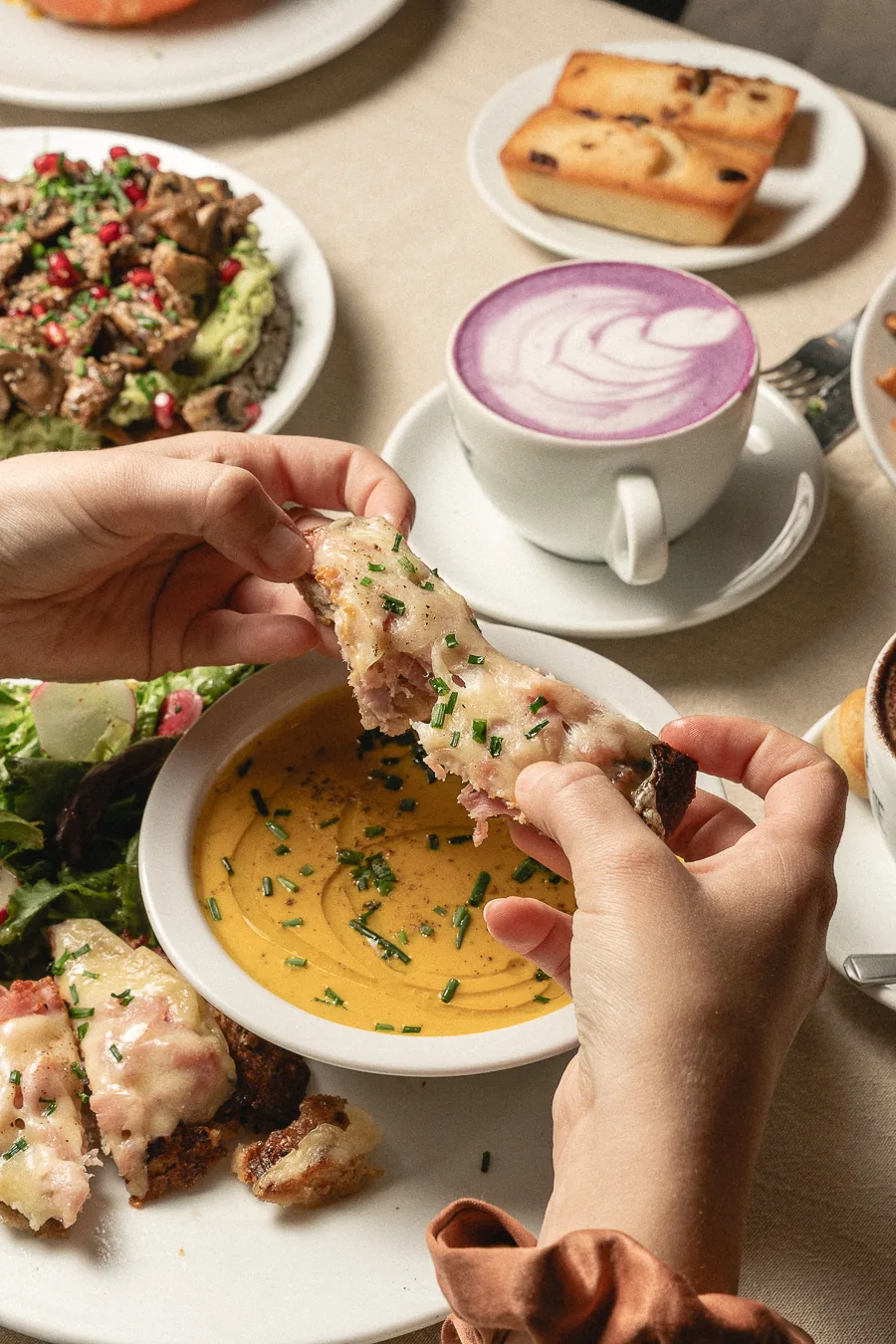
These venues focus on the quality of their coffee (local roasting, specialty beans, trained baristas) and on pastry preparations made in-house. You’ll find soft cookies, chocolate fondants that live up to their name, savory bacon-and-cheese scones, and pancakes that have nothing to do with industrial versions. The advantage for a corporate brunch: the team feels welcomed in a place with character, not in a meeting room disguised as a cafe.
Neighborhood residents frequent these addresses daily, which guarantees a form of validation through use: if the locals keep coming back week after week, it’s because the place delivers on its promises. To explore this direction further, several inspiration guides list Parisian cafes that combine quality service and flexibility for groups.
Restaurants with brunch formulas dedicated to companies
Some restaurants broaden their offering by proposing brunch formulas specifically designed for professional groups. The advantage over cafes: greater capacity (up to 50-60 people), a kitchen equipped to handle volume, and often staff experienced in event management.
These establishments generally offer several levels of service: standard formula (continental buffet + a few hot dishes), intermediate formula (enriched buffet, premium drink options), and prestige formula (chef in an open kitchen, plated service, food-and-drink pairings). You book several weeks in advance, pay a deposit, and confirm the final menu a week before the date.
A few Parisian addresses have specialized in this niche: bistronomy restaurants in the 10th or 11th, contemporary brasseries in the Marais, neo-bourgeois tables in the 9th. The average rate runs around 35-45 euros per person, privatization included if a minimum order is reached.
Unusual and hybrid venues
To break away from the cafe or restaurant framework, you can explore hybrid venues: art galleries with a lounge corner, book-cafes, concept stores with a dining area. These addresses create an interesting shift and leave an impression, but require more organization: you often have to go through an outside caterer for the culinary aspect, manage equipment logistics (tables, chairs, tableware), and coordinate several providers.
Another option: rooftops and hidden terraces. Paris has several dozen of them, often unknown to the general public. A rooftop brunch, with a view over the Haussmannian roofs, creates a photogenic moment (useful if you want to feed the company’s social media) and offers a welcome visual breather. Beware of the weather though: these venues mostly work from May to September, and require a backup plan in case of rain.
🗓️ Organizing logistics: from booking to the big day
Timeline and planning ahead: start three to six weeks before
A corporate brunch requires preparation. Allow at least three weeks for a group of 15-20 people, six weeks for an event of more than 40 participants or with full privatization. This timeframe allows you to compare several venues, negotiate terms, confirm the menu, and communicate clearly with the team.
A typical schedule looks like this: six weeks before, list potential venues and send a quote request to three or four addresses. Four weeks before, visit the two finalists and make your choice. Three weeks before, confirm the number of participants (with a 10% margin), pay the deposit, confirm the final menu. Two weeks before, send the official invitation to the team with all practical information (address, time, any dress code, access map). One week before, reconfirm the exact number and any special dietary requirements.
Draw up a shortlist of 3-4 addresses compatible with the budget and group size. Send a quote request by email specifying date, time, and estimated number of participants.
Visit the two finalist venues at the same time as the planned event. Taste the coffee, check the acoustics, gauge accessibility. Negotiate the final terms.
Sign the quote, pay the deposit (generally 30-50%), receive written confirmation. Block the date in the team’s calendar.
Send the detailed invitation, collect attendance confirmations, pass on the final number and any special dietary requirements to the venue. Plan a point of contact for the day.
Internal communication and managing registrations
A clear invitation avoids misunderstandings. It should specify: exact date and time (“Saturday June 12th, from 10:30 am to 1 pm”), full address with access map, dress code if relevant (“casual attire,” “business casual”), and context of the event (“brunch launching the new product,” “celebrating quarterly results”).
For groups of more than 20 people, a registration management tool simplifies tracking: Google Forms, Doodle, or an internal event platform. Ask for confirmation of attendance, particular dietary requirements, and possibly an open question (“a topic you’d like to discuss during the brunch?”) to fuel conversations.
Follow up a week before with those who haven’t responded. On the day, allow a 5% margin: two or three people prevented from attending at the last minute, sometimes offset by a colleague who spontaneously joins. Communicating this adjusted number to the venue 48 hours in advance helps avoid waste or, conversely, running short on quantities.
Entertainment and brunch schedule: letting it breathe or structuring it
A corporate brunch is not a seminar: no need to fill every minute with a tight program. The idea is to let it breathe, to allow conversations to arise naturally, without forcing interactions. Some organizers still plan a few milestones: welcome remarks from the manager at 10:45 am, a collective toast at 11:30 am, then a free informal moment.
If the goal includes a team-building component, you can slip in a light activity: a collective quiz about the company (without falling into heavy corporate territory), a “quirky questions” card game to break the ice, or an express creative workshop (customizing tote bags, an introduction to latte art if the venue allows it). Entertainment should never smother the brunch: it enriches it, it doesn’t replace it.
Ideal duration: 1.5 to 2 hours. Below that, there isn’t enough time for real exchanges. Beyond that, energy drops and people start checking their watches. Plan a fifteen-minute margin at the end of the slot for latecomers or those who want to linger over one last coffee.
💬 Experience feedback and pitfalls to avoid
Classic mistake: underestimating dietary requirements
Announcing “vegetarian brunch possible” and discovering on the day that the only vegetarian option is a green salad and two slices of toast is the best way to create frustration. Special diets are not marginal constraints: they concern 15 to 20% of participants on average (vegetarians, vegans, gluten or lactose intolerances, nut allergies).
Solution: ask explicitly during registration, pass the information on to the venue with associated names (“3 vegetarians: Marie, Thomas, Lucas; 1 gluten-free: Sophie”), and check on the day that the options are clearly identified on the buffet. Some venues use small flags or labels to avoid any confusion.
Common mistake: neglecting acoustics and ambient noise
A packed cafe on a Saturday morning, with a coffee machine hissing every three minutes, overlapping conversations, and an EDM playlist in the background, makes exchanges impossible. People end up shouting to be heard, conversations fragment, and the goal of team cohesion falls apart.
During the preliminary visit, test the acoustics: ask the manager to simulate the usual noise level at the planned time, check whether the space has sound-absorbing materials (carpet, fabrics, acoustic ceiling), and favor back rooms or partial privatizations that isolate from the main flow. A good corporate brunch takes place in a sound cocoon where voices carry without effort.
| 🏠 Brunch in a classic room | 🌳 Brunch in a privatized space |
|---|---|
| Lively atmosphere, the energy of an active venue, controlled cost. But noise is hard to control, no total privacy, less flexible hours. | Guaranteed calm, freedom for entertainment, confidentiality of conversations. But a higher price (privatization fee), sometimes less authenticity. |
Pitfall to avoid: confusing corporate brunch with a work meeting
Projecting a PowerPoint during a brunch kills the atmosphere. Handing out files to read between bites does too. A corporate brunch works precisely because it isn’t a meeting: it’s a moment of sharing, of decompression, of connection. If the goal is to brief the team on a strategic topic, organize a classic meeting followed by a brunch, rather than mixing the two.
Some organizers think they’re doing well by planning “themed tables” where each group discusses a specific topic. Result: participants feel trapped in a disguised workshop, when they simply hoped to eat pancakes in peace. Letting conversations emerge naturally often produces more value than any imposed format.
Frequently asked questions
How far in advance should you book a corporate brunch in Paris?
For a group of 15 to 25 people, book three to four weeks in advance. Beyond 30 participants or if you want full privatization, allow six weeks. Weekends and certain time slots (10 am-12 pm on Saturdays) fill up quickly at popular venues. Contacting several venues at once lets you compare availability and rates.
What budget should you plan per person for a quality corporate brunch?
Plan on 28 to 42 euros per person for a complete buffet (sweet and savory, hot drinks, fresh juices, service included). À la carte formulas for small groups start at 22-25 euros. High-end services with exclusive privatization and premium options can go up to 60-80 euros. Added to these rates are sometimes privatization fees (200-500 euros) and the service tip.
How do you manage special dietary requirements during a group brunch?
Ask explicitly during registration (online form or confirmation email) whether participants have dietary restrictions: vegetarian, vegan, gluten-free, allergies. Pass this list on to the venue with the associated names at least a week in advance. On the day, check that the options are clearly identified on the buffet (labels, small flags). A good venue should be able to adapt its offering without it becoming a headache.
Can a corporate brunch be organized on a weekday or only on weekends?
Both work. A weekday brunch (Tuesday-Thursday, 8:30-10:30 am) generally costs 15 to 20% less and allows work to resume afterward. A weekend brunch (Saturday morning, 10 am-12 pm) offers a more relaxed setting but uses up the team’s free time, so it should be reserved for exceptional events. Some venues accept intermediate slots: Friday morning or Monday midday.
Should entertainment be planned, or should the brunch unfold naturally?
Letting it breathe works better than multiplying entertainment. You might plan a brief welcome remark (5 minutes maximum), a collective toast, and let conversations emerge naturally. If you want a team-building component, slip in a light activity (quiz, quirky card game) that enriches without smothering. The goal remains human connection, not a packed program.
Which Parisian neighborhoods should be favored for a successful corporate brunch?
The 9th arrondissement (Martyrs, Abbesses), the Marais, the 10th and the 11th combine neighborhood identity, transport accessibility, and quality coffee offerings. Avoid ultra-touristy areas (Champs-Élysées, Eiffel Tower) where prices are inflated for average quality. The venue should be accessible in under 30 minutes for most of the team, ideally in a neighborhood they know or want to discover.
{“@context”:”https://schema.org”,”@type”:”FAQPage”,”mainEntity”:[{“@type”:”Question”,”name”:”How far in advance should you book a corporate brunch in Paris?”,”acceptedAnswer”:{“@type”:”Answer”,”text”:”For a group of 15 to 25 people, book three to four weeks in advance. Beyond 30 participants or if you want full privatization, allow six weeks. Weekends and certain time slots (10 am-12 pm on Saturdays) fill up quickly at popular venues. Contacting several venues at once lets you compare availability and rates.”}},{“@type”:”Question”,”name”:”What budget should you plan per person for a quality corporate brunch?”,”acceptedAnswer”:{“@type”:”Answer”,”text”:”Plan on 28 to 42 euros per person for a complete buffet (sweet and savory, hot drinks, fresh juices, service included). À la carte formulas for small groups start at 22-25 euros. High-end services with exclusive privatization and premium options can go up to 60-80 euros. Added to these rates are sometimes privatization fees (200-500 euros) and the service tip.”}},{“@type”:”Question”,”name”:”How do you manage special dietary requirements during a group brunch?”,”acceptedAnswer”:{“@type”:”Answer”,”text”:”Ask explicitly during registration (online form or confirmation email) whether participants have dietary restrictions: vegetarian, vegan, gluten-free, allergies. Pass this list on to the venue with the associated names at least a week in advance. On the day, check that the options are clearly identified on the buffet (labels, small flags). A good venue should be able to adapt its offering without it becoming a headache.”}},{“@type”:”Question”,”name”:”Can a corporate brunch be organized on a weekday or only on weekends?”,”acceptedAnswer”:{“@type”:”Answer”,”text”:”Both work. A weekday brunch (Tuesday-Thursday, 8:30-10:30 am) generally costs 15 to 20% less and allows work to resume afterward. A weekend brunch (Saturday morning, 10 am-12 pm) offers a more relaxed setting but uses up the team’s free time, so it should be reserved for exceptional events. Some venues accept intermediate slots: Friday morning or Monday midday.”}},{“@type”:”Question”,”name”:”Should entertainment be planned, or should the brunch unfold naturally?”,”acceptedAnswer”:{“@type”:”Answer”,”text”:”Letting it breathe works better than multiplying entertainment. You might plan a brief welcome remark (5 minutes maximum), a collective toast, and let conversations emerge naturally. If you want a team-building component, slip in a light activity (quiz, quirky card game) that enriches without smothering. The goal remains human connection, not a packed program.”}},{“@type”:”Question”,”name”:”Which Parisian neighborhoods should be favored for a successful corporate brunch?”,”acceptedAnswer”:{“@type”:”Answer”,”text”:”The 9th arrondissement (Martyrs, Abbesses), the Marais, the 10th and the 11th combine neighborhood identity, transport accessibility, and quality coffee offerings. Avoid ultra-touristy areas (Champs-Élysées, Eiffel Tower) where prices are inflated for average quality. The venue should be accessible in under 30 minutes for most of the team, ideally in a neighborhood they know or want to discover. {“@context”:”https://schema.org”,”@type”:”FAQPage”,”mainEntity”:[{“@type”:”Question”,”name”:”How far in advance should you book a corporate brunch in Paris?”,”acceptedAnswer”:{“@type”:”Answer”,”text”:”For a group of 15 to 25 people, book three to four weeks in advance. Beyond 30 participants or if you want full privatization, allow six weeks. Weekends and certain time slots (10 am-12 pm on Saturdays) fill up quickly at popular venues. Contacting several venues at once lets you compare availability and rates.”}},{“@type”:”Question”,”name”:”What budget should you plan per person for a quality corporate brunch?”,”acceptedAnswer”:{“@type”:”Answer”,”text”:”Plan on 28 to 42 euros per person for a complete buffet (sweet and savory, hot drinks, fresh juices, service included). À la carte formulas for small groups start at 22-25 euros. High-end services with exclusive privatization and premium options can go up to 60-80 euros. Added to these rates are sometimes privatization fees (200-500 euros) and the service tip.”}},{“@type”:”Question”,”name”:”How do you manage special dietary requirements during a group brunch?”,”acceptedAnswer”:{“@type”:”Answer”,”text”:”Ask explicitly during registration (online form or confirmation email) whether participants have dietary restrictions: vegetarian, vegan, gluten-free, allergies. Pass this list on to the venue with the associated names at least a week in advance. On the day, check that the options are clearly identified on the buffet (labels, small flags). A good venue should be able to adapt its offering without it becoming a headache.”}},{“@type”:”Question”,”name”:”Can a corporate brunch be organized on a weekday or only on weekends?”,”acceptedAnswer”:{“@type”:”Answer”,”text”:”Both work. A weekday brunch (Tuesday-Thursday, 8:30-10:30 am) generally costs 15 to 20% less and allows work to resume afterward. A weekend brunch (Saturday morning, 10 am-12 pm) offers a more relaxed setting but uses up the team’s free time, so it should be reserved for exceptional events. Some venues accept intermediate slots: Friday morning or Monday midday.”}},{“@type”:”Question”,”name”:”Should entertainment be planned, or should the brunch unfold naturally?”,”acceptedAnswer”:{“@type”:”Answer”,”text”:”Letting it breathe works better than multiplying entertainment. You might plan a brief welcome remark (5 minutes maximum), a collective toast, and let conversations emerge naturally. If you want a team-building component, slip in a light activity (quiz, quirky card game) that enriches without smothering. The goal remains human connection, not a packed program.”}},{“@type”:”Question”,”name”:”Which Parisian neighborhoods should be favored for a successful corporate brunch?”,”acceptedAnswer”:{“@type”:”Answer”,”text”:”The 9th arrondissement (Martyrs, Abbesses), the Marais, the 10th and the 11th combine neighborhood identity, transport accessibility, and quality coffee offerings. Avoid ultra-touristy areas (Champs-Élysées, Eiffel Tower) where prices are inflated for average quality. The venue should be accessible in under 30 minutes for most of the team, ideally in a neighborhood they know or want to discover.”}}]}”}}]}