

Cover photo: @lapuertaontheroad
Banana bread was born in American kitchens during the 1930s, when throwing away an overripe banana was considered a domestic scandal. Housewives transformed this blackened fruit into a moist cake, and the recipe crossed the Atlantic to settle on Parisian countertops. Today, every coffee shop has its own version: with pecans, chocolate, sometimes even tahini. But the best remains the one that respects the essentials: very ripe bananas, a dense golden crumb, that cinnamon scent that grabs you from the entrance.
In Paris, banana bread has become a coffee shop staple, to the point where you can find it almost everywhere. But not all are created equal. Some are dry, others too sweet, a few lack character. We’ve tested the addresses that truly make a difference, those where banana bread is worth crossing the city for.
Why banana bread captivates Parisians 🍌
An American pastry turned Parisian classic
Banana bread arrived from the United States, where it was born during the Great Depression, a clever way to use overripe bananas rather than throwing them away. Nothing sophisticated: flour, sugar, eggs, butter, mashed bananas. A simple cake that takes 10 minutes to prepare and bakes for an hour.
In Paris, it quietly made its way into coffee shops from the 2010s onward, carried by the American brunch wave. Today, it appears on nearly every specialty coffee shop menu. Not as an exceptional pastry, but rather as a reassuring landmark. You know you can eat it for breakfast, as an afternoon snack, with a cappuccino or a matcha latte.
What makes good banana bread (and what ruins it)
A good banana bread is first and foremost about texture. Moist without being gummy, dense without being heavy. When you sink your fork in, it gives way gently. No compact crumb that sticks to your palate, no dryness that forces you to take three sips of coffee to swallow.
The banana flavor should be distinct, not masked by sugar. The best versions use truly ripe bananas, the ones nobody wants in the fruit bowl anymore, covered with brown spots. That’s when the fruit develops its most intense aromas, that natural sweetness that replaces part of the added sugar.
💡 Our advice
Banana bread served at room temperature reveals its flavors better than refrigerated banana bread. If the slice comes from the fridge, let it sit for a few minutes, the texture softens, the aromas return.
Add-ins matter too. Pecans, walnuts, dark chocolate chips: these additions bring crunch and contrast. Some coffee shops add spices, cinnamon, nutmeg, cardamom, that enhance the taste without overpowering it. Others prefer simplicity: just the banana, nothing else.
The best coffee shops for banana bread in Paris
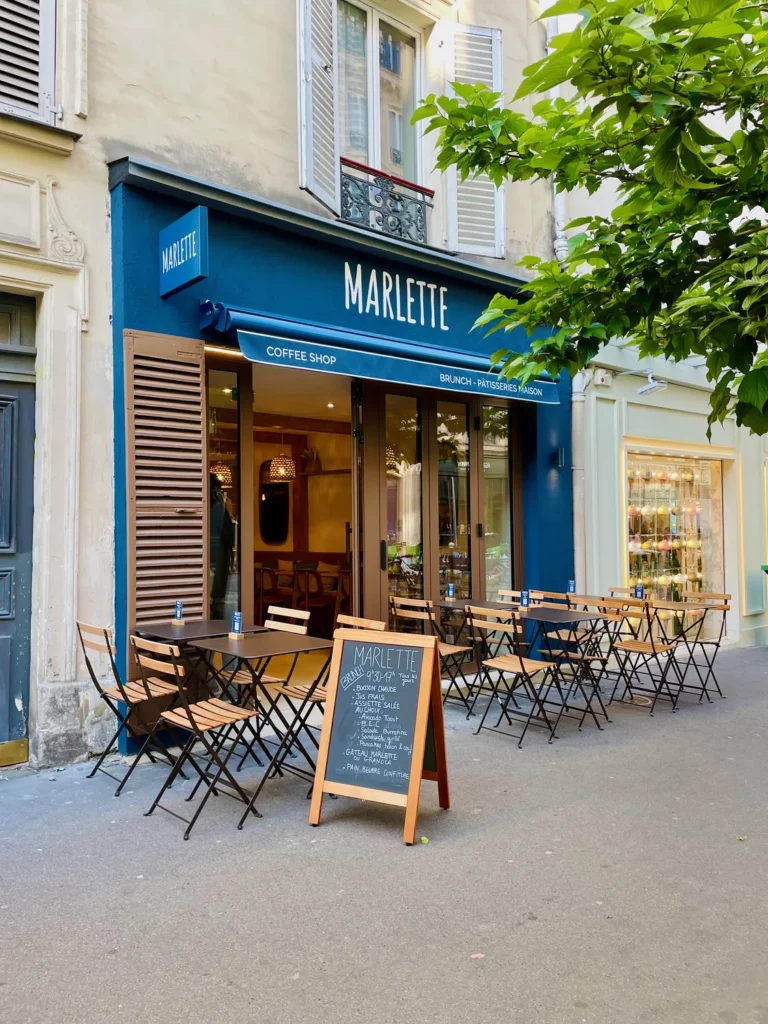
Marlette: banana bread as it should always be
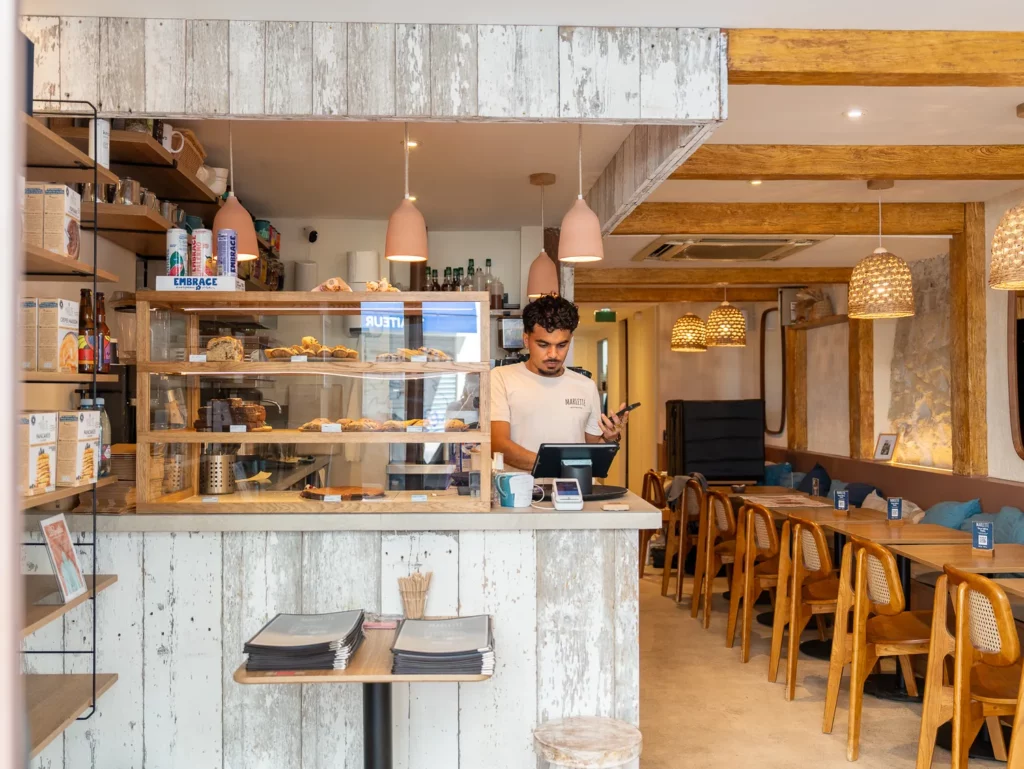
At Marlette, banana bread is one of those preparations you recognize from the first bite. Moist, fragrant, generous. The recipe favors very ripe bananas, a touch of cinnamon, crushed walnuts. No frills, just the balance you expect.
Two locations in Paris: 51 rue des Martyrs in the 9th, 45 rue des Abbesses in the 18th. Both cafés share the same philosophy, one of slowing down, of Sunday mornings when nobody checks the time. Banana bread is enjoyed here with a cappuccino or a Chai latte, in an atmosphere that invites you to settle in and stay.
The baked goods are prepared in-house on île de Ré, then delivered fresh to the Parisian coffee shops. No reservations possible at Marlette during brunch hours, you stop by to see if there’s a spot, like you’d drop in on a neighbor. Tables can be booked from 3 to 5 p.m. at reservation@marlette.fr.
Mornings before 11am or afternoons after 3pm: off-peak hours guarantee a table without waiting. On weekends, expect a bit of a crowd.
No table service for banana bread. You order directly, pick up your plate, and find a seat.
Banana bread pairs particularly well with an Ube latte or Matcha latte, the flavors complement each other without competing.
Holybelly: the historic American brunch address
Holybelly opened in 2013 in the 10th arrondissement, on rue Lucien Sampaix. At the time, few Parisians knew about fluffy American pancakes, creamy scrambled eggs, crispy bacon. Sarah Mouchot, the founder, imported this comfort food, and with it, banana bread.
The recipe is generous, with plenty of banana and a touch of dark chocolate. The texture leans toward dense rather than airy, which appeals to those looking for a filling snack. Served warm, slightly caramelized on the edges, it pairs well with a flat white or filter coffee.
Holybelly has since opened a second location on rue de Cléry, Holybelly 5. Banana bread remains a menu staple there, available all day.
Ten Belles: simplicity and precision
Ten Belles is first and foremost a roaster. Coffee is taken seriously here, timed extraction, controlled temperature, specialty beans. The pastries follow the same logic: no excess, just what’s needed.
The banana bread at Ten Belles is simple. Ripe bananas, flour, brown sugar, a bit of butter. No chocolate chips, no exotic spices. Just the taste of the fruit, highlighted by precise baking. The crumb stays moist for hours after coming out of the oven.
Two locations: rue de la Grange aux Belles in the 10th, and rue Bréguet in the 11th. The atmosphere is calm, almost studious. People come to work on their laptops, read, or simply enjoy a moment without background noise.
Variations on banana bread 🎨
Chocolate-hazelnut banana bread
Some coffee shops add dark chocolate chips to the batter, others add crushed hazelnuts. The chocolate brings a bitterness that balances the banana’s sweetness. Hazelnuts create a textural contrast, you bite, then find the moistness again.
The chocolate-hazelnut version works well for an afternoon snack. It’s more indulgent, less neutral than classic banana bread. With a cappuccino, it works. With black tea, too.
Vegan banana bread
Replacing eggs with applesauce or ground flaxseeds, butter with coconut oil: the vegan version of banana bread is multiplying in Parisian cafés. The result is often denser, slightly less airy, but just as moist.
The banana flavor comes through more, since dairy products no longer coat it. Some find this more straightforward, more direct. Others prefer the roundness that butter brings. A matter of taste.
✅ Worth knowing
A well-made vegan banana bread is almost indistinguishable from a classic banana bread. If the café doesn’t specify it on the menu, you might not guess it when tasting.
Gluten-free banana bread
Rice flour, buckwheat flour, or a blend of both: gluten-free banana bread requires adjustments. The texture changes, often a bit more crumbly, less elastic. But when done right, the moistness is still there.
In Paris, a few addresses offer a gluten-free version permanently. Others make it occasionally, depending on flour availability. If this concerns you, it’s better to call ahead before making the trip.
How to recognize homemade banana bread
Visual cues
Homemade banana bread never looks like industrial banana bread. The crust is irregular, sometimes cracked on top, a sign that the batter rose freely in the oven. The color varies from pale golden to caramelized brown, depending on the banana ripeness and baking temperature.
The slices aren’t all identical. Some are thicker, others thinner. Walnut or chocolate pieces are distributed randomly, not like on a production line. If you see a perfectly symmetrical slice, wrapped in plastic, with a printed label: run away.
Texture to the touch
Press gently with your finger on the crumb. Fresh banana bread slowly returns to shape, without leaving a dent. If it stays compressed, it’s too dry or has spent too much time in the fridge. If it crumbles under pressure, it was baked too long or the recipe lacks fat.
| 🏠 Homemade | 🏭 Industrial |
|---|---|
| Irregular crust, sometimes cracked Moist crumb, slightly sticky Distinct ripe banana aroma Visible fruit or nut pieces |
Smooth, uniform surface Dry crumb, sponge-like texture Dominant sugar taste No visible pieces, completely homogeneous |
The taste test
Take a bite. Close your eyes. If you immediately recognize the taste of banana, not an artificial flavor, but the fruit itself, that’s a good sign. If you detect a hint of cinnamon, nutmeg, or natural vanilla, even better. These spices don’t mask the banana, they highlight it.
Industrial banana bread often has a chemical aftertaste, a flat sweetness that doesn’t vary from one bite to the next. Homemade banana bread evolves in your mouth: you discover the moistness first, then the banana, then the spices or nuts. Each slice is a small experience.
Banana bread in Parisian habits
For breakfast: the croissant alternative
The croissant is France. But some mornings, you prefer something more substantial, that sticks to your ribs without weighing you down. Banana bread fills this role. A thick slice, a filter coffee, a fresh orange juice: the trio works.
Unlike a croissant, banana bread doesn’t crumble everywhere. You can eat it while walking, on the metro, on a bench. Practical for those who leave early and don’t have time to sit down.
For afternoon snack: the adult quatre-heures
Around 4pm, the energy slump hits. Banana bread, with its natural sugar and slow carbs, gives you a boost without the jitters of an espresso. Parisians have understood this: you increasingly see it accompanying tea or matcha latte in mid-afternoon.
Some coffee shops offer it slightly warmed, with a dollop of salted butter melting on top. An indulgent, comforting version that transforms the snack into a small ritual.
Sunday afternoon: banana bread as a pretext
On Sundays, Paris slows down. Coffee shops fill with people who have nowhere to go, who linger with a book or notebook. Banana bread then becomes a pretext, to settle in, to order a second drink, to stay another hour.
You share it for two, cut it into small pieces, make it last. It’s no longer really a pastry, more an accessory of Parisian Sundays, just like the newspaper you never finish or the terrace you occupy until you get cold.
Where to buy banana bread to go 🛍️
Artisanal bakeries that make it
A few Parisian bakeries have integrated banana bread into their range, alongside country loaves and fruit tarts. It’s rarer than in coffee shops, but when it’s there, it’s often very good. Bakers master the baking, texture, and balance of flavors.
Du Pain et des Idées, in the 10th, sometimes offers banana bread on its seasonal menu. La Maison d’Isabelle, in the 16th, makes a chocolate-banana version that sells out quickly on Saturday mornings. Chambelland, the gluten-free specialist, offers a rice flour banana bread that surprises with its moistness.
Fine food shops and concept stores
Some fine food shops sell pre-packaged banana bread, often supplied by local pastry chefs. Merci, the Marais concept store, offers artisanal pastries in its café, including a pecan banana bread that changes regularly depending on the partner pastry chef.
La Grande Épicerie de Paris, at Bon Marché, offers several banana bread references in its pastry section. Quality varies by brand, but you can generally find at least one decent option.
Ordering online (with caution)
A few pastry chefs offer home delivery of banana bread via platforms like Epicery or Nestor. Convenient if you’re organizing brunch and short on time. However, always check the preparation date, banana bread older than three days loses freshness.
⚠️ Keep in mind
Banana bread delivered cold often has a different texture than the one enjoyed on-site. Reheat it for 20 seconds in the microwave or 5 minutes in the oven at 150°C to restore the moistness.
Beyond Paris: banana bread elsewhere in France 🇫🇷
Lyon: the brunch capital also does banana bread
Lyon adopted American brunch almost at the same time as Paris. Addresses like Slake Coffee House or Season Square offer homemade banana breads, often with walnuts and chocolate. The Lyon approach favors generous portions, one slice is plenty for a snack.
Bordeaux: the local touch of the southwest
In Bordeaux, some coffee shops add hazelnuts from Lot-et-Garonne to their banana bread. Plume Small Kitchen, on rue des Remparts, makes a banana bread with Aquitaine honey that differs from the classic sweet version. The texture remains faithful to the original, but the floral honey taste brings a local signature.
Marseille: banana bread and laid-back vibes
Marseille has its own way of seeing banana bread: more relaxed, often served outdoors, on a terrace overlooking the Vieux-Port. At Café Pépin or La Caravelle, you enjoy it with fresh orange juice, feet in the sun. The atmosphere matters as much as the recipe.
Mistakes to avoid when ordering banana bread
Getting it too early in the morning
Banana bread fresh from the oven is tempting. But the texture isn’t stabilized yet, the crumb is too hot, almost pasty. Wait at least 30 minutes after baking. If you arrive when the café opens and the banana bread has just been set out, be patient.
Microwaving it too long
Reheating banana bread is good. Turning it into a dry sponge is unfortunate. In the microwave, 15 to 20 seconds is enough. Beyond that, moisture evaporates and the crumb hardens. If you have an oven, use it instead: 5 minutes at 150°C restores all the moistness without drying it out.
| ✅ Do | ❌ Avoid |
|---|---|
| • Ask if it’s homemade • Check the preparation date • Let it come to room temperature • Pair with an unsweetened hot beverage |
• Ordering it straight from the oven • Reheating more than 20 seconds • Pairing with an overly sweet drink (industrial juice, soda) |
Pairing it with an overly sweet drink
Banana bread already contains quite a bit of sugar. If you order it with industrial fruit juice or an overly sweet chai latte, it becomes cloying. Opt for black coffee, plain tea, matcha latte without added sugar, or fresh orange juice without sweetener.
Making your own banana bread: is it really simpler?
The basic recipe in 10 minutes
Making homemade banana bread requires neither sophisticated equipment nor advanced technique. You need: 3 very ripe bananas, 200g flour, 150g sugar, 100g melted butter, 2 eggs, one teaspoon baking powder, a pinch of salt. Mash the bananas with a fork, mix all ingredients in a bowl, pour into a buttered loaf pan, bake 50 minutes at 180°C.
The result is honest. Not exceptional, but significantly better than what you find in supermarkets. If you add crushed walnuts or chocolate chips, it goes up a notch.
Classic beginner mistakes
First mistake: using bananas that aren’t ripe enough. A bright yellow banana, without brown spots, will never yield a flavorful banana bread. You need almost black bananas, the ones nobody wants to eat as is. That’s when the fruit’s natural sugar is at its peak.
Second mistake: overmixing the batter. Banana bread isn’t an airy cake. Mix just until the flour is incorporated, no more. If you beat too long, the crumb becomes elastic and compact.
Homemade vs. buying: the calculation
A slice of banana bread in a Parisian coffee shop costs between €3.50 and €5. A whole homemade banana bread (8 to 10 slices) costs about €4 in ingredients. Financially, it’s clearly more advantageous to make it yourself.
But there’s time. An hour between preparation and baking. Cleaning. The risk of failure. And above all, the absence of that Parisian café atmosphere, that 10am light, that server who knows your name. Sometimes, paying €4.50 for a slice means buying much more than a pastry.
If you’re looking for other gourmet addresses in Pariscoffee shops remain your best allies, they combine quality, atmosphere, and that spontaneity that makes Parisian Sundays special.
Frequently asked questions
What’s the difference between banana bread and banana cake?
No fundamental difference: banana bread is simply the American name for banana cake. The basic recipe remains identical, mashed bananas, flour, sugar, eggs, fat. In France, we sometimes say cake à la banane, but in Parisian coffee shops, the term banana bread has taken hold to mark the influence of American brunch culture.
How long does homemade banana bread keep?
Banana bread well wrapped in plastic wrap or aluminum foil keeps 3 to 4 days at room temperature. In the refrigerator, it lasts up to a week, but the texture becomes firmer. You can also freeze it in individual slices: it then keeps 2 to 3 months and defrosts quickly in the toaster or oven.
Can you make banana bread without added sugar?
Yes, if you use very ripe bananas, almost black, that contain enough natural sugar. You can supplement with blended dates or unsweetened applesauce to add binding and sweetness. The result will be less sweet than classic banana bread, but just as moist if proportions are respected.
Why is my banana bread too dry?
Three main causes: baking too long, not enough fat in the recipe, or insufficiently ripe bananas. Check doneness with a toothpick, it should come out slightly moist, not completely dry. Increase the amount of butter or oil by 10 to 20g if the recipe seems too dry. And always use very ripe bananas.
Is banana bread better hot or cold?
At room temperature, slightly warm. Fresh from the oven, it’s too hot, the texture isn’t stabilized and the flavors are masked by heat. Cold, straight from the fridge, it loses moistness and the banana flavor fades. Ideal: let it cool 20 to 30 minutes after baking, or reheat a cold slice for 15 seconds in the microwave.
What fruits can you substitute for banana in banana bread?
Applesauce works well, but the taste is much more neutral. Butternut squash puree gives a similar texture with a slightly sweet note. Some use cooked and mashed sweet potato, which brings moistness and an orange color. But no fruit exactly reproduces the aroma and density of ripe banana.