


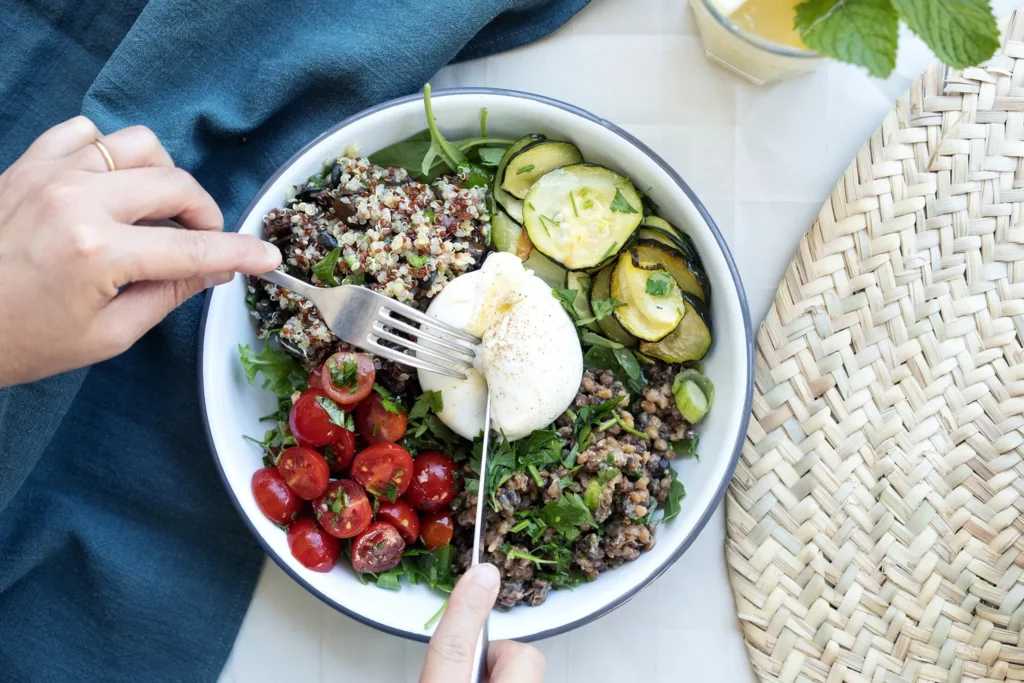
There’s that 8 a.m. light. The kind that streams through the window as you set your bowl on the table. The moment when the city wakes, when your body calls for fuel. A healthy breakfast isn’t about giving up pleasure—it’s just about choosing better what goes in it.
Because between marketing promises and your body’s real needs, there’s often a world of difference. We’re telling you everything about this first meal that can change your day, without making you feel guilty in front of your pain au chocolat.
🥣 What Really Makes a Difference in Your Bowl

Protein, Your Anti-Craving Shield
You know that empty-stomach feeling at 10:30? It’s often the sign of a breakfast that’s too sweet. Protein slows sugar absorption and extends satiety. Concretely: plain yogurt, two scrambled eggs, or almond butter toast change everything.
Plant proteins work just as well: soaked chia seeds, fortified oat milk, or silken tofu blended with fruit. The goal? Between 15 and 20 grams of protein first thing in the morning to stabilize your blood sugar.
💡 Our tip
If you’re not hungry in the morning, don’t force it. Start with a dairy drink (plant-based or not) with a handful of nuts. Your appetite will gradually return.
Complex Carbs to Last Until Noon
White bread? It spikes your blood sugar, then drops it just as fast. Result: guaranteed energy crash. Choose whole-grain bread, multigrain, or sourdough—their glycemic index is gentler. Rye bread is even richer in fiber, with a slightly tangy taste that pairs well with fresh cheese.
Oat flakes are another slow-carb champion. Warm porridge with fresh fruit and a spoonful of honey keeps you full. Oat fiber captures some of the fats and sugars in your gut, a real help for your digestion.
Good Fats, the Kind That Don’t Make You Gain Weight
For years, you’ve been told that fat is the enemy. Except your brain runs on lipids. Toast with mashed avocado, almond butter, or a soft-boiled egg—that’s premium fuel. The omega-3s in peanut butter or flaxseed even boost your concentration.
Products like coconut oil (unrefined) or tahini add creamy texture to your preparations. Just watch quantities: one tablespoon is enough. Fat is calorie-dense.
🍓 Fruit, Morning Stars

Fresh, They’re Bursting with Vitamins
A kiwi contains more vitamin C than an orange. A ripe banana provides potassium and naturally sweetens your bowl without added honey. Red fruits—raspberries, blueberries, strawberries—are packed with antioxidants that protect your cells from oxidative stress.
The rule? Eat fruit whole rather than as juice. You keep the fiber that slows sugar absorption. A crunchy apple = 4 grams of fiber. A glass of apple juice? Nearly zero. And your pancreas will thank you.
6.4 g
of fiber in a medium pear—one third of your daily needs
Dried or Dehydrated, Sugar Concentration
Dried figs, dates, apricots: they’ve lost their water, so their sugar content explodes. Three dates = the carb equivalent of a whole banana. Use sparingly, as a natural sweetener in your oat porridge or yogurt.
If you choose them organic, you avoid preservatives like sulfur dioxide. But careful: organic doesn’t mean lower calorie. It’s just cleaner ingredient-wise.
The Store-Bought Juice Trap
A glass of commercial orange juice, even 100% pure, is 20 grams of sugar without the fruit’s fiber. Your liver treats it like light soda. If you love juice in the morning, dilute it with sparkling water (half and half), or press your fruit yourself just before drinking.
Green juices based on vegetables (spinach, cucumber, celery) with a touch of apple or lemon are less sweet. A real detox drink without being extreme.
🍞 Bread and Alternatives: Sorting It Out

Which Bread to Choose in the Morning
Natural sourdough whole-grain bread is the sensible choice. Whole grain fiber slows digestion, and sourdough partially pre-digests gluten—good news if you have a sensitive gut. Rye bread is even richer in fiber, with a slightly tangy taste that pairs well with fresh cheese.
Seeded bread (flax, sunflower, pumpkin) adds essential fatty acids and crunch. If you find it at an artisan bakery, check the ingredient list: flour, water, salt, sourdough. Period. No added sugar, no hidden palm oil.
- White baguette: high glycemic index, little fiber
- Whole-grain bread: 3 times more fiber, B vitamins preserved
- Rye bread: very filling, pronounced flavor
- Multigrain bread: good texture/nutrition compromise
Gluten-Free Alternatives
Puffed rice cakes, brown rice bread, or buckwheat toast: they’re fine if you’re intolerant. But beware, many industrial gluten-free products are loaded with sugar and additives to compensate for taste. Read labels.
Brown rice bread has a decent glycemic index if it’s truly whole grain. White puffed rice bread? Might as well eat candy. The crispy texture is deceptive, but nutritionally, it’s empty.
Smart Spreading
Forget commercial spreads—even organic ones often contain 50% sugar. Make your own: hazelnut butter, unsweetened cocoa, liquid honey, pinch of salt. Blended for 2 minutes, and you control the ingredients.
On the savory side: hummus, mashed avocado with lemon juice, or fresh cheese whipped with herbs. These spreads provide quality protein and fats, far more interesting than overly sweet jam.
✅ Remember
A balanced breakfast combines whole-grain bread (slow carbs), a protein source (egg, yogurt, nut butter), and fresh fruit (vitamins + fiber). The winning trio to last all morning.
☕ What Drink to Start With

Coffee, Friend or Foe?
A cup of black coffee in the morning is 2 calories and a shot of caffeine that improves concentration. But if you drown it in sugar and cream, you cancel the benefits. Coffee also stimulates your metabolism: it helps slightly reduce hunger and burn a few extra calories.
The classic mistake? Drinking it on an empty stomach if you have a fragile stomach. In that case, first eat a piece of whole-grain bread with almond butter, then your coffee. Your digestive tract will thank you.
Tea, Herbal Teas and Hot Alternatives
Green tea contains catechins, antioxidants that support your liver. Black tea provides as much caffeine as coffee, but more gradually. Rooibos or mate infusions are caffeine-free, perfect if you want to reduce your stimulant intake.
A hot drink in the morning is also a ritual that forces you to slow down. At Marlette, we champion this philosophy of suspended time—taking 10 minutes for yourself before the city swallows you.
Plant-Based Drinks, User Guide
Oat, soy, almond, hazelnut milk: they all have different nutritional profiles. Soy milk is richest in protein (about 3 g per 100 ml). Oat milk is milder, naturally slightly sweet, and pairs well with coffee.
Choose them plain and unsweetened. Flavored versions (vanilla, chocolate) often contain added sugar. And check that they’re fortified with calcium and vitamin B12 if you’re 100% plant-based—these nutrients are essential.
| Drink type | Advantages | Watch out for |
|---|---|---|
| Black coffee | Energy boost, 0 calories | Avoid on empty stomach if sensitive |
| Oat milk | Mild, soluble fiber | Low protein, choose plain version |
| Soy milk | High in protein | Strong taste, check organic origin |
| Green tea | Antioxidants, gentle caffeine | Don’t steep too long (bitterness) |
🥛 Dairy Products and Alternatives

Plain Yogurt, a Safe Bet
Plain whole yogurt is 5 grams of protein, calcium, and probiotics that support your gut flora. Skip the 0% fat versions: whole milk lipids slow sugar absorption and promote assimilation of fat-soluble vitamins (A, D, E, K).
You can sweeten it yourself with a spoonful of chestnut or acacia honey, or chopped fruit. An industrial fruit yogurt often contains 15 to 20 grams of added sugar—as much as a cookie.
Fromage Blanc and Petits-Suisses
3% fat fromage blanc is richer in protein than yogurt: up to 8 grams per 100 g. Its thick texture makes it a perfect base for an indulgent bowl: add red berries, a handful of homemade granola, and a drizzle of honey.
Plain petits-suisses (not the sweetened children’s versions) are an option if you like creamy textures. Again, favor whole milk versions, less processed.
100% Plant-Based Alternatives
Soy, coconut, or oat yogurts are multiplying on shelves. Their asset: no lactose, making them digestible for the intolerant. Their limitation: often lower in protein (except soy), and sometimes sweetened to mask natural bitterness.
A homemade plant-based option: blend silken tofu with a ripe banana and a spoonful of almond butter. Mousse-like texture, plenty of protein, and you control the sugar.
Plain whole yogurt, 3% fromage blanc, or unsweetened soy plant-based version.
Raspberries, blueberries, or sliced banana. Fruit provides vitamins and fiber.
Oat flakes, chia seeds, or some crushed walnuts for texture.
🍯 Sweetening Without Guilt

Honey, Agave Syrup, Maple Syrup: What to Choose
Raw (unheated) honey contains enzymes and antioxidants that white sugar lacks. But it’s still sugar: about 80% carbs. A teaspoon is enough to sweeten yogurt or porridge. Chestnut honey has a slightly lower glycemic index than acacia honey.
Agave syrup is richer in fructose—it sweetens more, so you use less. But excess fructose tires your liver. Pure maple syrup (grade A amber) provides manganese and zinc, but remains caloric.
Hidden Sugars in Breakfast Products
Commercial cereals often advertise “high in fiber,” but contain 30% sugar. Cereal bars? Same story. A packet of “breakfast” cookies can hide 15 grams of sugar—that’s 3 cubes—for 4 cookies.
Read labels: if sugar appears in the first 3 ingredients, that’s a bad sign. Choose products with less than 10 grams of sugar per 100 grams.
Can You Do Without Added Sugar?
Yes. Your taste buds adapt in 2 to 3 weeks if you gradually reduce. Start by halving the honey in your tea. Replace sweet cereals with plain oat flakes with a mashed banana.
Fresh fruit is often enough to sweeten naturally. A grated apple in your porridge, red berries on your whole-grain bread with fresh cheese: you don’t even need to add anything.
⚠️ Keep in mind
Artificial sweeteners (aspartame, sucralose) trick your brain: it expects sugar, doesn’t get it, and may push you to compensate later in the day. Better a little real honey than fake sugar.
🍴 Building Your Ideal Plate

Macro Balance in Practice
A balanced breakfast roughly follows this breakdown: 40-50% complex carbs, 20-30% protein, 20-30% quality fats. That gives, for example: 2 slices of whole-grain bread (carbs + fiber), a soft-boiled egg (protein + fats), a handful of red berries (vitamins + fiber), an oat milk coffee (drink + calcium).
No need to weigh to the gram. The idea: each nutrient family is represented. Your body knows how to do the rest.
Savory Version vs Sweet Version
Scrambled eggs with sautéed vegetables, rye bread and avocado: that’s a balanced breakfast that fills you up. Egg protein + whole-grain bread fiber + avocado’s good fats = winning combo.
Sweet version: oat porridge with almond milk, sliced banana, crushed walnuts, drizzle of honey. You get the same nutrient families, just on a different plate.
“Breakfast like a king, dine like a pauper. The body needs energy at the start of the day, not at night before sleeping. A hearty breakfast helps reduce late-afternoon cravings.”
— Chrononutrition principle
Mistakes That Sabotage Your Breakfast
- Systematically skipping breakfast: your body goes into energy-saving mode, and you risk grabbing anything at 11 a.m.
- 100% sweet breakfast: croissant + orange juice + sweet coffee = blood sugar spike, then sharp drop.
- Eating standing up in 3 minutes: your brain doesn’t register satiety if you swallow everything in a rush. Sit down, chew, take 10 minutes.
- Oversized portions: even balanced, if you eat for two, your stomach will suffer. A reasonable bowl is enough.
If you’re looking for concrete composition ideas, our complete brunch and breakfast guide details lots of tested (and approved by our neighborhood regulars) combos.
🌱 Is a Plant-Based Breakfast Really Balanced?

Plant Proteins at Wake-Up
You can totally cover your protein needs without eggs or yogurt. Chia seeds (4 g protein for 2 tablespoons), peanut butter (8 g for 2 tablespoons), or blended silken tofu (10 g per 100 g) do the job.
Combine grains (oat flakes, whole-grain bread) with legumes (hummus, chickpea puree) or nuts (almonds, walnuts) to get a complete amino acid profile. Your body will reconstruct the proteins it needs.
Calcium and Vitamin B12: Points of Vigilance
If you go 100% plant-based, watch your calcium intake. Fortified plant milks, sesame seeds (tahini), or almonds provide it. Aim for 300 mg at breakfast—about 250 ml fortified oat milk + a handful of almonds.
Vitamin B12 only exists in animal products (or fortified foods/supplements). If you’re vegan, take a supplement or choose fortified cereals. Non-negotiable: B12 is vital for your nervous system.
Examples of 100% Plant-Based Breakfasts
- Smoothie bowl: frozen banana, red berries, soy milk, chia seeds, homemade granola. Blended thick, served in a bowl with crunchy toppings.
- Avocado-hummus toast: toasted whole-grain bread, homemade hummus, mashed avocado, pumpkin seeds, pinch of fleur de sel.
- Coconut-banana porridge: oat flakes cooked in coconut milk, sliced banana, crushed cashews, drizzle of maple syrup.
Each version provides carbs, proteins, fats, fiber, and micronutrients. Balanced plant-based eating exists, you just need a bit of method.
Frequently Asked Questions
Can you have a healthy breakfast without being hungry in the morning?
Yes, listen to your body. If you’re really not hungry when you wake up, start with a hot drink (tea, oat milk coffee) and a handful of nuts or a piece of fruit. Your appetite will gradually return during the morning. The important thing is not to force yourself, but also not to arrive starving at noon and grab anything.
How long does it take to prepare a balanced breakfast?
Between 5 and 10 minutes if you opt for simple formulas: whole-grain bread + almond butter + fresh fruit, or plain yogurt + oat flakes + honey. Hot porridge takes 5 minutes to cook. If you’re really short on time, prepare the night before: overnight oats (oat flakes soaked overnight in plant milk) or chia pudding. In the morning, you just add fresh fruit.
Does a savory breakfast make you gain more weight than sweet?
No, that’s a misconception. What matters is your plate’s overall balance and quantity. A savory breakfast with eggs, whole-grain bread and vegetables can be perfectly balanced and less caloric than a bowl of industrial sweet cereals. The advantage of savory: it avoids the morning blood sugar spike, so fewer cravings before noon. At equal calories, neither makes you gain more weight than the other.
Can you eat dried fruit every morning without gaining weight?
Yes, if you control quantities. A small handful (20-30 g) of dried figs, dates or apricots provides fiber, iron and magnesium. But they’re very concentrated in sugar: 3 dates = about 60 calories. Use them as a natural sweetener in your porridge or yogurt, rather than snacking on a whole bag. Always prioritize fresh fruit first, dried as a complement.
Should you wait a certain time after waking before eating?
Not necessarily, but many people aren’t hungry in the first 30 minutes after waking. That’s normal: your digestive system starts up gradually. If you like intermittent fasting, you can postpone your first meal by 1 to 2 hours. Otherwise, listen to your body: as soon as you’re hungry, eat. There’s no universal rule, just your biological rhythm to respect.
Can smoothies replace a solid breakfast?
Yes, if you compose them correctly. A balanced smoothie contains whole fruit (with fiber), a protein source (soy plant milk, plain yogurt, or protein powder), good fats (almond butter, chia seeds), and possibly a base of leafy greens (spinach). Avoid 100% fruit smoothies that spike your blood sugar like regular juice. And sip it slowly: your brain needs time to register satiety.